

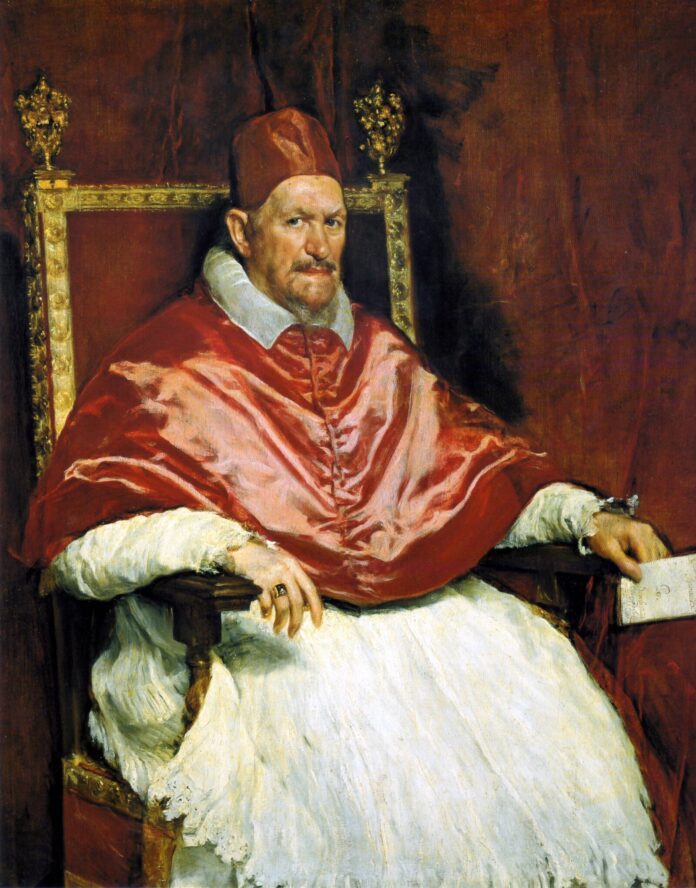
Rome is getting a major Diego Velázquez exhibition, Velázquez e l’Italia, at Palazzo Barberini in March 2027, but you do not have to wait: the most famous picture he painted in Italy, the Portrait of Pope Innocent X, hangs today in the Galleria Doria Pamphilj on Via del Corso, a twenty-minute walk from Palazzo Barberini, for a 16 euro ticket. The exhibition will be presented to the press on 25 November, and until then the list of loans stays under wraps. What we already know is that it is the third chapter of a three-year programme at the national gallery of ancient art, after Bernini e i Barberini and the single-masterpiece show built around Vermeer’s Woman in Blue Reading a Letter. If you are in Rome this winter, our advice is clear: see the pope first, then come back for the show.
Velázquez, court painter to Philip IV of Spain, came to Italy twice. The first time, between 1629 and 1631, he was a young man studying Titian, Raphael and Michelangelo; the second, between 1649 and 1651, he was famous and travelling to buy art for the king. During that second stay he painted Innocent X Pamphilj, probably in the summer of 1650, as the light linen suggests. The canvas shows a seventy-five-year-old man with a flushed face and a suspicious stare, and it flatters him not at all. A story that historians treat with caution, but that Romans have repeated for centuries, says the pope looked at it and exclaimed “Troppo vero!”, too true. True or not, it sums up what the painting still does to anyone who walks into its small room.
The detail that makes it unique comes three centuries later. Francis Bacon became obsessed with this portrait and painted more than forty-five variations on it between the 1950s and the early 1960s, the so-called screaming popes; the best known, Study after Velázquez’s Portrait of Pope Innocent X, dates from 1953. If you know Bacon’s caged, howling figures and have never seen the original, the Doria Pamphilj offers one of the most surprising experiences in Rome: discovering that the scream was already there, held back behind that stare. The gallery is still a private family collection inside a palace, with Caravaggio, Titian and Raphael on the walls and an audio guide in English included in the ticket, so it rewards a slow morning visit far more than a rushed stop.
Plan around one simple rule: the Galleria Doria Pamphilj is closed every Wednesday, which is the most common mistake visitors make. It opens Monday, Tuesday and Thursday from 9am to 7pm and Friday to Sunday from 10am to 8pm, with last entry one hour before closing. Once the Barberini exhibition opens in March, expect more people to follow the same trail, so this winter is the quiet moment to go. The gallery sits halfway between Piazza Venezia and the Pantheon, which makes it easy to combine with a morning of sightseeing in the historic centre and lunch nearby.
Make it a full Roman day. After a morning with Velázquez, swap palaces for street food. Top Rome Street Food runs small-group food tours in Trastevere and the centre with local guides, including a vegetarian-friendly Roman tour, stopping at the bakeries, supplì counters and trattorias Romans actually use. It is the easiest way to taste the real city in a few hours.
Quick facts
- See now: Portrait of Pope Innocent X, Galleria Doria Pamphilj, Via del Corso 305
- Hours: Monday, Tuesday, Thursday 9am to 7pm; Friday to Sunday 10am to 8pm; closed Wednesday; last entry one hour before closing
- Tickets: 16 euro, 17 euro booked online; free under 12 (1 euro online)
- Coming up: Velázquez e l’Italia, Palazzo Barberini, Via delle Quattro Fontane 13, from March 2027
Image: Diego Velázquez, Portrait of Innocent X, about 1650 / Wikimedia Commons, public domain